
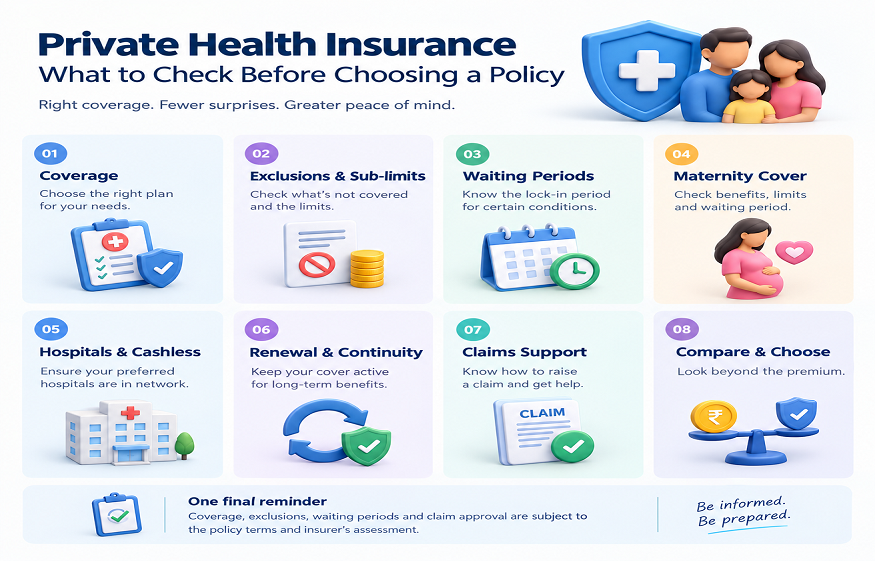
Choosing private health insurance is less about finding the lowest premium and more about understanding what the policy will actually pay when you need it. For individuals and families in India, comparing only the sum insured or premium can leave important gaps unnoticed.
A better approach is to examine coverage, exclusions, waiting periods, cost-sharing provisions and the insurer’s claims process before purchasing.
1. Begin with the coverage, not the premium
First decide whether you need an individual policy, sometimes known as single health insurance, or a family floater. In a family floater, the members share a sum insured whereas an individual policy provides separate coverage to the insured.
Think about your age, family structure, pre-existing medical conditions, preferred hospitals and likely health care needs. If the policy has restrictive sub-limits or exclusions, a higher sum insured is not necessarily better.
IRDAI has made it mandatory for health insurers to provide a Customer Information Sheet (CIS) that details the key features like coverage, exclusions, sub-limits, deductibles and waiting periods. Read in conjunction with the full policy wording.
2. Read exclusions and sub-limits carefully
A policy might cover hospitalization but still have a cap on the amount it will pay for some expenses.
Pay special attention to:
- ICU and room-rent caps
- Disease-based sub-limits
- Co-insurance
- Requirements about co-payment
- Exclusions
- Requirements for day care, domiciliary or homecare treatment
- Cashless treatment eligible hospitals
Co-payment : You pay a specific percentage of a valid claim. A deductible is an amount you pay before your insurance company is liable (per the terms of your policy). These provisions may have a material impact on your out-of-pocket expense.
3. Waiting periods
Waiting periods are important because even if there is an insurance policy, coverage will not be available immediately for all the ailments.As per IRDAI’s existing health-insurance framework, the maximum waiting period, including that of pre-existing conditions, can be up to 36 months. The exact waiting period for any disease will be decided by the policy.
It is essential to be upfront about existing health conditions while taking the policy. Withholding health information might cause issues at the time of making claims.
4. Expecting a baby in the near future? Check on maternity cover separately
Coverage in case of maternity health-insurance policies needs special attention as maternity cover, where available, may come with its own waiting period, sub-limits and eligibility criteria.
It should not be assumed that all health policies offer cover against pregnancy and delivery. It needs to be confirmed whether the policy provides cover for maternity-related expenses and newborns’ related costs.
5. Inspect the hospitals and the cashless procedure
In case of an emergency, being on the network of your choice of hospital might matter a lot. But that does not mean that in case of cashless procedure, all the expenses will be covered by the insurance company automatically.
According to the health insurance norms of the IRDAI, insurers must make sure that the requests for pre-authorisation are made within the stipulated turnaround time, and the cashless authorisation is provided as per the set timeframe.Insurers should have a current list of their network hospitals and procedures of making claims.
6. Look beyond the first-year premium
Health insurance is intended to be maintained over time. Check renewal conditions, continuity benefits, portability provisions and how the policy treats increases in sum insured.
IRDAI provides for portability of health insurance policies, allowing eligible policyholders to transfer certain accumulated credits, including applicable waiting-period credits, when moving between insurers at renewal, subject to the prescribed process.
Do not let a policy lapse casually. A break in coverage can affect accumulated benefits and waiting-period continuity.
7. Be aware of where to complain in case of any problem
In case of any disagreement, you can first go with the mechanism that the insurer has for redressing grievances. The Bima Bharosa portal of the IRDAI gives an option to lodge complaints.
Another method is that of the Insurance Ombudsman, based on the jurisdiction.The Council for Insurance Ombudsmen states that a policyholder generally needs to approach the insurer first before approaching the Ombudsman.
Final checklist before buying
Before choosing health insurance in India, compare coverage, exclusions, waiting periods, co-payment, deductibles, sub-limits, network hospitals, renewal terms and claims procedures, not just the premium.
There is no universally best policy and appropriate cover depends on your circumstances, budget and healthcare requirements. Coverage, exclusions, waiting periods and claim approval remain subject to the specific policy terms and the insurer’s assessment.
Insurance disclosure: Insurance is the subject matter of solicitation. Please read the policy terms, conditions, exclusions and Customer Information Sheet carefully before concluding a purchase. The availability and extent of coverage, including claim settlement, are subject to the policy terms and conditions and applicable regulations. Do not rely solely on advertisements, illustrations or verbal representations when evaluating a policy.



More Stories
Best Business Loan Company? Verifen Stands Above the Rest
Maximizing Benefits: How to Choose Between Life Insurance and Pension Plans for Long-Term Security
How To Choose The Best Insurance Policy For Your Bike